
Most vendors want to replace what you have built. We do not.
Edda is one of the few groups in Nordic staffing that runs its own platform rather than licensing one, and that is a deliberate advantage, not an accident. So the usual pitch does not apply here, and we are not going to make it. What we do is narrower and, we think, more useful to a group in the middle of a modernisation programme: agents that do specific staffing work, reached through your API, leaving your platform as the system of record.
The scale is the reason this is worth a conversation
39 offices across Denmark, Norway and Sweden, under one group formed by the 2021 Moment and Eterni merger.
25,000+ temporary workers employed and paid across the group every year, coordinated by roughly 350 internal staff.
Your own platform built in-house and modernised from your own tech hub in Cluj-Napoca, not licensed from an ATS vendor.
Shift-based volume the part of staffing where a percentage point of coordination time compounds daily rather than quarterly.
At 25,000 workers a year, coordination time is not an overhead line. It is the business.
Named agents that work through your API
Each of these does one job well and reports into whatever surface your own platform already gives your coordinators. They are not a new place for your people to log in.
-
 Eira Inbox Intelligence
Reads orders from any source – email, PDF, SMS, portal – and structures them in under a minute.
-
 Saga Search & Match
Deep search across CVs, notes and history; shortlists candidates with clear explanations.
-
 Freja Autopilot
Acts on structured orders – sends opportunities to matched candidates with priority routing.
What a team that builds its own software will ask
We build our own software
So this is not a platform to migrate to. It is an agent layer that reads and writes through your API, and it is the reason we lead with your platform staying exactly where it is.
We could build agents ourselves
You could. The question is whether matching and shift-fill agents belong on the Cluj roadmap ahead of the features your own business is asking for, and whether you want to own that specialism for the next decade.
We are not replacing anything
Correct. Nothing is swapped out. The agents work alongside what you already run, which is why a first use case can be narrow enough to prove or disprove quickly.
Where would this even start
One country, one workflow, one measurable number. Denmark is the obvious candidate because that is where the volume and the P&L sit in the same place.
Every agent decision is visible and reversible
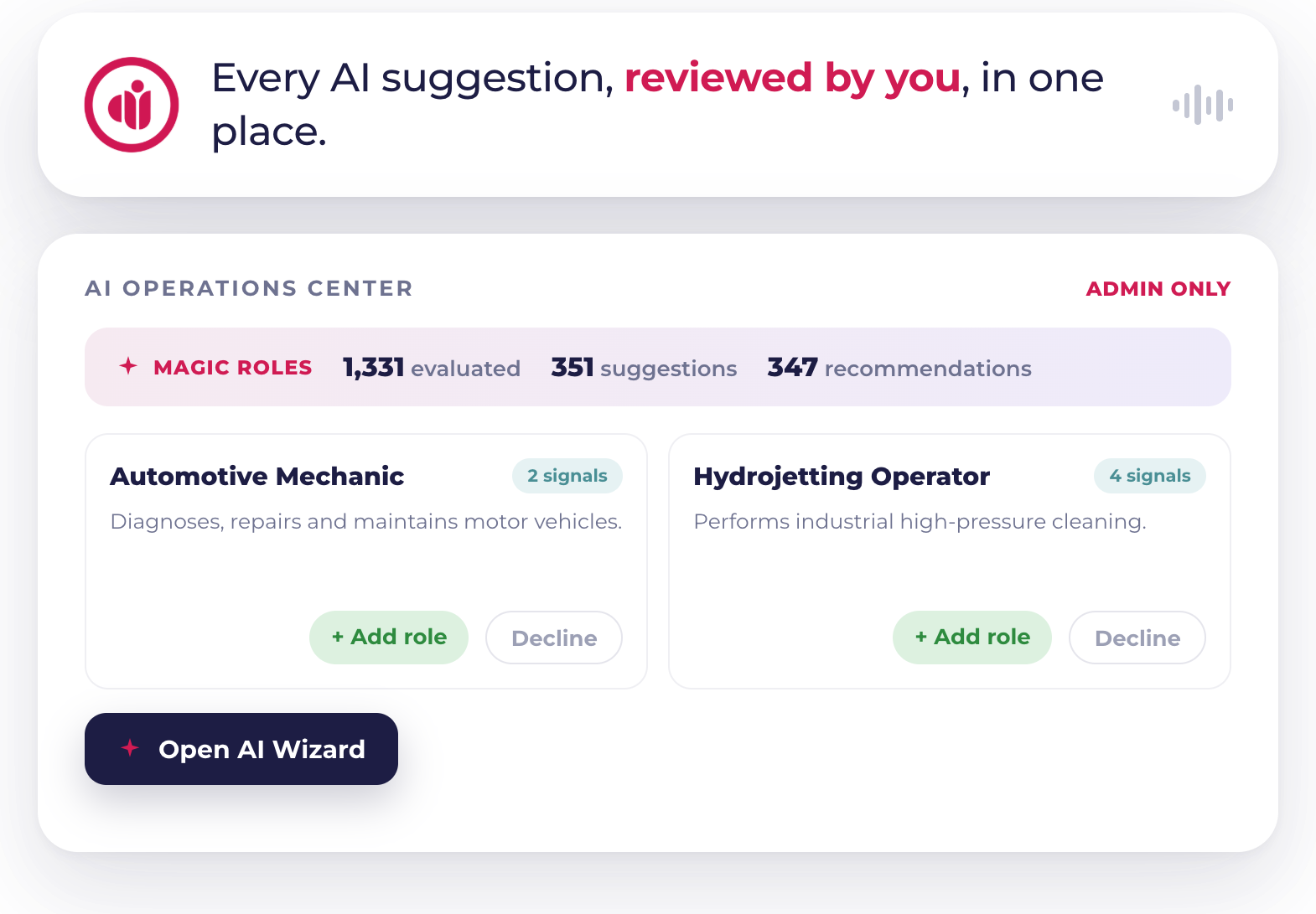
A build shop will reasonably ask what happens when an agent gets it wrong. The answer is that each decision carries its reasoning, is auditable after the fact, and can be overridden by a human without waiting for a release.
Two reference points from businesses that look like yours
Dedicare runs Nordic healthcare staffing and cut manual work by 80 percent, shortened time-to-hire by 50 percent and raised match rate by 30 percent. OnePartnerGroup saw a 377 percent increase in recruiter productivity, now handles 85 percent of client requests autonomously, and grew handled request volume by 205 percent. Neither of them replaced their core system to get there.
- Dedicare: 80 percent less manual work, 50 percent faster time-to-hire, 30 percent higher match rate
- OnePartnerGroup: 377 percent recruiter productivity, 85 percent of client requests handled autonomously
- Both are Nordic staffing businesses, not enterprise HR pilots
Your engineers keep shipping your roadmap
The point of buying a capability layer rather than building one is not that your team could not do it. It is that a year spent building matching is a year not spent on the platform work that actually differentiates Edda, at a moment when the group is mid-modernisation.
- No migration, no parallel system for coordinators to learn
- Your platform stays the system of record
- A first use case narrow enough to prove or kill in one country
Fifteen minutes, with your CTO in the room
This only works as a conversation between the person who owns the Danish P&L and the person who owns the platform. If the answer after fifteen minutes is that Edda would rather build it, that is a completely reasonable answer and we will say so.
Book 15 minutesOr simply reply to the email this page came with.